
Adjudication can provide a swift solution where negotiation is deadlocked
Adjudication is a dispute resolution method that allows either party to submit their dispute to an independent third party for an imposed decision. Adjudication is quick and relatively affordable but adversarial in nature. The short timescale of 28 days in which the decision is reached, unless extended, means that it is an intense and demanding process. Formalising a dispute through adjudication can result in a deterioration of the relationship between the parties. However, the speed of the process does permit parties to quickly move on and arrange their affairs according to the decision that is reached.
Adjudication ensures privacy of procedure and can facilitate the continuance of cash flow based on the advancement of a strong case where previous negotiation has reached deadlock. The threat of invoking adjudication can assist progression in other dispute methods such as mediation or conciliation. The right to refer a dispute is available ‘at any time’ for either party to a qualifying contract under the Construction Contracts Act 2013.
Adjudication timeline
The timeline and milestones of the adjudication process are dictated under the Construction Contracts Act 2013. Adjudication is a fast process, but it requires meticulous and careful preparation of evidence. If there is an error in preparation there is little or no opportunity to make a correction before its consequences are reflected in the adjudicator’s decision. The ability for the referring party to fully prepare in advance of issuing a Notice of intent to refer the dispute to adjudication, and the lesser time for the Respondent to compile and submit its response, results in a process that can favour the referring party.
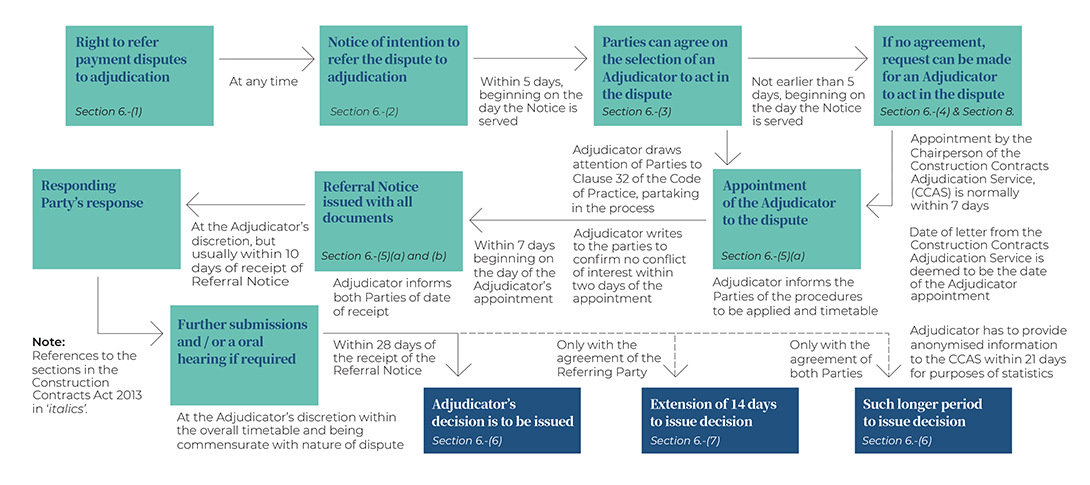
Notes:
- References to the Construction Contracts Act 2013 in italics.
- Construction Contracts Adjudication Service, is the nominating body on behalf of the Department of Business, Enterprise and Innovation.
“By failing to prepare you are preparing to fail.”
Benjamin Franklin, one of the founding
fathers of the United States of America
January 2021
January 2021
Adjudication case law
The establishment of adjudication as a primary process to resolve construction disputes was established following the publication of the seminal UK report ‘Constructing the Team’ 1 in July 1994. One of the recommendations was to adopt adjudication through standard contract forms without restriction on the issues that could be referred, with decisions implemented immediately. Construction adjudication was then introduced in the jurisdiction of England and Wales through the Housing Grants Construction and Regeneration Act 1996 (HGCRC 1996), which came into force in May 1998.
The HGCRC 1996 was supplemented by provisions of the Local Democracy, Economic Development and Construction Act 2009 (LDEDCA 2009) where the legislation is now more generally referred to as the UK Construction Act. It was then similarly adopted in the jurisdictions of Scotland and Northern Ireland shortly afterwards. In place for over 30 years there is now a considerable body of case law under the UK Construction Act.
The continued success of construction adjudication is evidenced by the extensive number of jurisdictions in which it has been introduced including Australia, Canada, Germany, Hong Kong, Malaysia, Mauritius, New Zealand, Singapore, South Africa and the United States. Construction adjudication is also promoted by international institutions including the International Chamber of Commerce (ICC), Federation International Des Eingenieurs-Conseils (FIDIC), and the United Nations Commission on International Trade Law (UNCITRAL).
It is widely acknowledged that the later Construction Contracts Act 2013 (CCA 2013), which came into force in Ireland on 25 July 2016, is similar and contains many of the principles of the UK Construction Act. However, it is important to note that the case law that has originated under the UK Construction Act is derived from legislation from a jurisdiction outside Ireland. Whilst this established body of law may be persuasive it is not binding in Ireland. This position was emphasised in the 2021 judgment of Aakon Construction and Pure Fitout 2 where Simons J stated:
“There is an understandable temptation for practitioners and judges in this jurisdiction to borrow from this extensive learning when interpreting and applying the Construction Contracts Act 2013. The case law from England and Wales must, however, be approached with a degree of caution. This is because there are significant differences between the legislative approaches adopted in the two jurisdictions.”
Since the CCA 2013 coming into force there has been a steady increase in the adoption of adjudication to resolve construction disputes in Ireland. From what was a slow take up in the first two years, the appointment of adjudicators, almost exclusively through the Construction Contracts Adjudication Service (CCAS), totalled 79 appointments in the year 2024/2025. Research confirms that decisions are issued in approximately 75% of appointments made, which is now circa 330 for the period mid-2018 to mid-2025.3
Reflecting the increasing use of adjudication to resolve construction disputes there is a now an evolving body of case law from the courts of Ireland. This case law arises from the necessity to seek court assistance to either enforce an adjudicator’s decision or to challenge an adjudicator’s decision. This evolving case law provides important binding, as opposed to persuasive, jurisprudence applicable to the CCA 2013 within the jurisdiction of Ireland. There are still some important points of principle that have yet to be settled through jurisprudence, where the Courts have advised that “…it is appropriate to proceed with caution” 4 adding that:
“The precise contours of the High Court’s discretion to refuse to enforce what is expressed under legislation to be a binding decision should be developed incrementally.” 5
The adjudication case law judgments of the Irish Courts, where available, are provided below. This body of jurisprudence is summarised in the adjacent guidance notes entitled ‘Adjudication court cases in Ireland and established jurisprudence.’
Notes:
- Latham, Sir Michael ‘Constructing the Team – Joint Review of Procurement and Contractual Arrangements in the UK Construction Industry’ – July 1994.
- Aakon Construction Services Limited and Pure Fitout Associated Limited [2021] 161 MCA, Simons J, 13.09.2021 at 40.
- Author’s continuing collection of data of institutional adjudicator appointments in Ireland, plus an estimate of 10% for party agreed appointments, for the years 2018/2019 to 2024/2025, where decisions are issued in approximately 75% of appointments.
- Supra 2 at 21.
- Supra2 at 21.
Adjudication judgments
BMC Renovation Ltd and Gael Property Investments Ltd [2026] IEHC 195.
Tenderbids Ltd trading as Bastion and Electrical Waste Management Ltd
[2026] IEHC 5.
Albert Connaughton and Timber Frames Projects Ltd T/A Timber Frame Ireland [2024] 644 MCA.
Tenderbids Ltd trading as Bastion and Electrical Waste Management Ltd [20] IEHC 139.
Finnegan Contracts Limited and Killycard Developments Limited [2024] 550 MCA.
McGill Construction Limited and Blue Whisp Limited [2024] IEHC 205.
DNCF Limited and Genus Homes Limited [2023] IEHC 40.
McGurran Civils ROI Limited and K&J Townmore Construction Limited [2023]
IEHC 355.
John Paul Construction Limited and Tipperary Co-Operative Creamery Limited [2022] 165 MCA.
Aakon Construction Services Limited and Pure Fitout Associated Limited [2021]
161 MCA.
Principal Construction Limited and Beneavin Contractors Limited [2021] MCA 199
Gravity Construction Limited and Total Highway Maintenance Limited [2021]
IEHC 19.
Resources
The Scheme for Construction Contracts (England and Wales) Regulations 1998
Construction Contracts Act 2013
Construction Contracts Act 2013 – Information Booklet
Code of Practice to the Construction Contracts Act 2013
Eighth Annual Report, implementation of the Construction Contracts Act 2013
Housing Grants, Construction and Regeneration Act 1996 – Part II Construction Contracts
King’s College London – 2024 Construction Adjudication Report
UNITRAL Model Clause on Adjudication – 2024
August 2026